
Wellness In Business: A Beginner’s Guide to Hazard Analysis Critical Control Point (HACCP)
The article “Wellness in Business: A Beginner’s Guide to Hazard Analysis Critical Control Point (HACCP)” explains HACCP’s role in identifying hazards, setting critical control points, and ensuring food safety. It emphasizes systematic monitoring, preventive measures, and compliance to protect consumers and strengthen business practices.
Jun Hao Bai
10/27/20258 min read


Dreaming of owning a food business in the future? From a small bakery or coffee shop to a full-scale restaurant, there are endless possibilities in the food industry. But before you even begin to think about your menu, branding, marketing strategies, and interior design, the most important ingredient for the success of your food business is ensuring food safety and wellness. This is for yourself, your team, and your future customers. After all, a good food business is built not only on flavor and creativity but also on trust and responsibility.
Wellness comes first before business, and in the food industry, this includes both personal health and the health standards you uphold in your operations. A healthy mind and body keep you energized to handle the demands of running a business, while a commitment to safe and nutritious food keeps your customers happy and protected. When wellness is prioritized, it becomes easier to maintain consistency, creativity, and the resilience needed to manage challenges in the food industry. Being a food entrepreneur means also being mindful of proper hygiene, safe handling practices, and clean preparation methods.
Nowadays, in this digital age, people are drawn to restaurants with unique concepts, delicious food, and warm, accommodating staff. A creative theme or an Instagram-worthy setup can easily attract customers to try a place for the first time. Customers notice everything, not just what’s on their plate. From the condition of the comfort rooms to the cleanliness of the dining area, down to the glasses used for service water, each detail will probably be described in their review. As such, when there are lapses in food and hygiene, it can actually be a reason for them not to go to that restaurant anymore.
In the food industry, safety and sanitation are really non-negotiable. Prioritizing hygiene and food safety protects your customers’ health and even strengthens your brand’s reputation. But how can you make sure that the food you serve is not only delicious but also consistently safe for everyone?
<!-- wp:image {"id":8160,"sizeSlug":"full","linkDestination":"none"} -->
<figure class="wp-block-image size-full"><img src="https://foodmicrobiology.academy/wp-content/uploads/Screenshot-2025-10-27-at-11.26.03.png" alt="" class="wp-image-8160"/></figure>
<!-- /wp:image -->
Photo from: https://www.istockphoto.com/search/2/image-film?phrase=haccp
Wellness It Is: What is HACCP?
Hazard Analysis and Critical Control Points or HACCP is a science-based food safety or food hygiene approach that uses systematic preventive methods to protect foods and consumers from hazards or contaminants. These hazards may be chemical (such as pesticides, cleaning agents, or food additives), physical (foreign objects like glass, metal, or plastic fragments), or biological (like bacteria, viruses, parasites).
These hazards also can enter food at any point in the food chain, from production, processing, and storage to distribution and preparation. Furthermore, HACCP can also be applied at every stage of the food chain. Its implementation must be guided by scientific evidence of risks to human health.
Before HACCP, quality control on food was primarily managed through TQM or Total Quality Management, a system which was introduced by W. Edward Deming. For better understanding, here’s a timeline:
1960s: HACCP was developed by NASA and Pillsbury to produce safe, crumb-free, pathogen-free foods with long shelf life for space travel.
1971: HACCP was formally introduced to the food industry at the First National Conference on Food Protection.
1972: Pillsbury trained FDA inspectors in HACCP; the system was adopted in U.S. low-acid canning regulations.
1980: WHO and the International Commission on Microbiological Safety of Foods (ICMSF) promoted HACCP in a published report.
1983: WHO Europe officially recommended HACCP use.
1985: The National Academy of Science endorsed HACCP as an effective method for ensuring safe food.
1992: The National Advisory Committee on Microbiological Criteria for Foods (NACMCF) established the seven core principles of HACCP.
1993: The Codex Alimentarius Commission (under FAO/WHO) adopted HACCP guidelines, giving it global recognition.
1994: International HACCP Alliance and Safe and Quality Foods (SQF) were formed.
Mid-1990s: The European Union began requiring HACCP in food businesses through directives and later regulations.
2000: Global Food Safety Initiative was formed which allowed for benchmarking the components of differing schemes. This was made as a requirement in the supply chain in the US.
Australia was among the earliest and most proactive countries in adopting HACCP during the 1980s, with its implementation being largely industry-driven. This early adoption was influenced by the nation’s heavy reliance on food exports, which required strict safety measures to maintain market access. Similarly, Canada has a long tradition of food safety regulation and became the first country to establish a national system based on HACCP principles. In 1992, it launched the Quality Management Program (QMP), initially applied to its fish and seafood sector.
HACCP is an effective and rational way of assuring food safety from farm to fork. Other benefits include more effective and strategic use of resources, and more timely response to food safety problems. Rather than relying solely on testing the final product, HACCP emphasizes prevention by assessing risks and establishing effective control points. The system is also flexible, allowing it to adapt to changes such as new equipment, updated processing methods, or technological innovations.
<!-- wp:image {"id":8161,"sizeSlug":"full","linkDestination":"none"} -->
<figure class="wp-block-image size-full"><img src="https://foodmicrobiology.academy/wp-content/uploads/Screenshot-2025-10-27-at-11.26.51.png" alt="" class="wp-image-8161"/></figure>

<!-- /wp:image -->
Photo from: https://www.istockphoto.com/search/2/image-film?phrase=restaurant+safety
Being a preventive framework, it has the ability to identify and control potential risks before they become problems. As such, it is a helpful tool for businesses. By managing hazards effectively, companies can minimize waste, reduce costs, and save resources, ultimately improving operational efficiency. More importantly, implementing HACCP safeguards brand reputation by demonstrating a strong commitment to food safety. On the consumer side, it provides trust and confidence, assuring people that the food they eat is both safe and of high quality, while lowering the likelihood of foodborne illness.
From a compliance standpoint, HACCP enables businesses to meet both national and international food safety regulations, supports smoother trade across borders, and aligns operations with global standards such as Codex and ISO 22000. A successful HACCP implementation is built on the foundation of good work ethic and teamwork, since it requires a coordinated, team-based approach.
In addition to food industries, HACCP is also applied to other industries like pharmaceuticals and cosmetics.
Building Wellness in Business: HACCP Principles
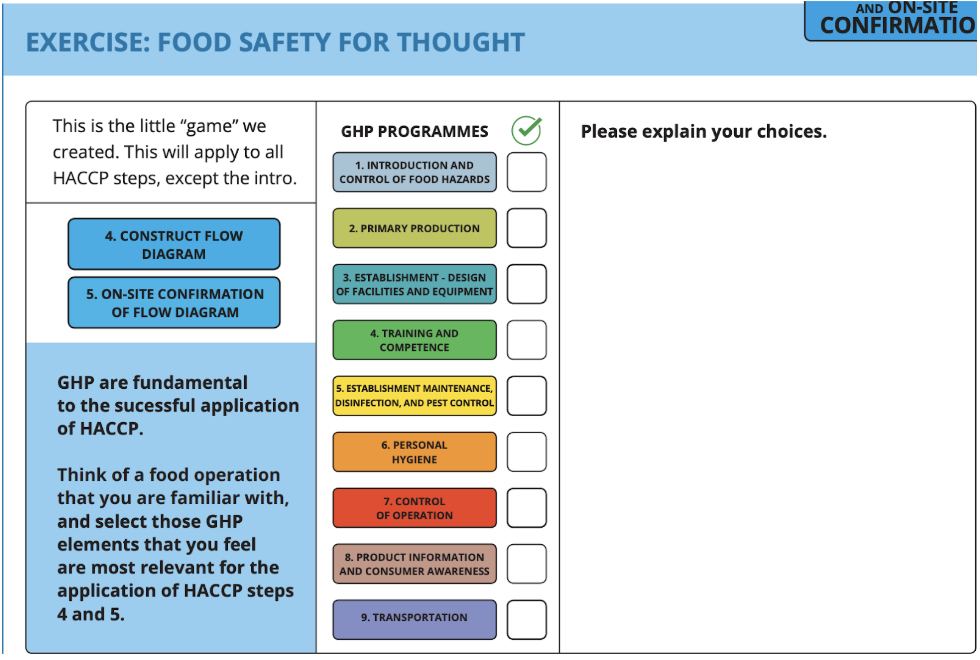
Before applying HACCP principles, several prerequisite steps must be completed. First, a HACCP team should be formed, composed of individuals from different areas of expertise such as engineering, sanitation, and food microbiology. This team is responsible for preparing and developing the HACCP plan. Second, the product must be clearly described, including its ingredients, processing methods, intended use, and target consumers. Third, a process flow diagram should be constructed to illustrate each step of production in detail. Finally, the HACCP team must verify the flow diagram by conducting an on-site review of operations to ensure its accuracy and completeness, making and documenting modifications as needed.
<!-- wp:image {"id":8162,"sizeSlug":"full","linkDestination":"none"} -->
<figure class="wp-block-image size-full"><img src="https://foodmicrobiology.academy/wp-content/uploads/Screenshot-2025-10-27-at-11.29.28.png" alt="" class="wp-image-8162"/></figure>
<!-- /wp:image -->
Photo from: https://openknowledge.fao.org/server/api/core/bitstreams/7fcf9d3e-54e8-4693-98e7-e4dc9e214ed4/content
Once the prerequisite steps are completed and the HACCP plan is prepared, the next stage is to apply the seven core principles of HACCP. The 7 principles are the following:
Inventory of all potential hazards
This means identifying any biological, chemical, or physical hazards that could make the food unsafe.
It is important to consider the ingredients and raw materials, each step in the process, product storage and distribution, and final preparation and use by the consumer.
Example: Checking raw chicken for bacteria like Salmonella or hair that could accidentally get into a food product.
Set the critical control points
This refers to the points in the process where control can be applied and where hazards can be prevented, eliminated, or reduced to safe levels.
It is important to document for product safety purposes.
Example: thermal processing, chilling, product formulation control, and testing ingredients for chemical residues.
Give each critical control point the critical limits
This is described as the maximum and/or minimum value to ensure each CCP is under control. It is used to distinguish between safe and unsafe operating conditions at a CCP.
It is important to know the difference between critical limits and operational limits
Example: duration of the transport of the product, method of transporting the product, production date and shelf life
Determine how the critical control points are monitored
This involves the sequence of observations and measurements to be assessed. It is preferred that the monitoring is continuous and monitoring equipment is accurately calibrated.
It is important because it facilitates the tracking of the operation.
Examples: temperature measuring, recording and checking allergen information against specifications, control the processing or expiry dates
Determine the corrective actions for each critical control point
This refers to the plans and strategies to do if monitoring shows a CCP is not within the critical limit.
It is important to prevent foods from reaching the consumers and protect their health.
Example: improving cooling efficiency, improving cleaning methods, and changing working methods.
Verification and validation
This determines the validity of the HACCP plan and confirms that the HACCP system is working correctly and effectively controlling hazards.
It is important to note that individuals involved in this process must be highly knowledgeable.
Example: having an outsider check look at your approach, periodically checking if the HACCP approach is effective
Documentation and registration
This should include a summary and a really detailed record of all the procedures, monitoring, and corrective actions.
It is important to ensure accountability and can be used to improve processes over time.
Example: ingredients for which critical limits have been established, corrective actions, employee training records
Read more here: https://foodsafepal.com/haccp/
<!-- wp:image {"id":8163,"sizeSlug":"full","linkDestination":"none"} -->
<figure class="wp-block-image size-full"><img src="https://foodmicrobiology.academy/wp-content/uploads/Screenshot-2025-10-27-at-11.31.48.png" alt="" class="wp-image-8163"/></figure>

<!-- /wp:image -->
Photo from: https://www.istockphoto.com/search/2/image-film?phrase=hands+together+team
If you are part of a small business or a home-based food entrepreneurs, here are some practical steps to implement HACCP in your kitchen or business:
Choose Your Team Wisely and Strategically
Select team members who have knowledge in key areas like food preparation, sanitation, and ingredient handling.
This may include a manager, supervisors, and operatives.
Even a small team should cover all critical aspects of food safety.
Assign Ownership of the HACCP Plan
Designate someone with technical expertise to take responsibility for the HACCP plan, ensuring it is correctly implemented and maintained.
Invest in Staff Training
Educate all team members on food safety practices, HACCP principles, and their specific roles in maintaining a safe food environment.
It is also important to recognize the need for adapting and improving ways of working. This should be paired with hands-on experience.
Maintain and Review of HACCP Plan
Regularly check and update the plan to reflect changes in processes, ingredients, equipment, or regulations, and ensure it continues to effectively manage hazards.
This may include listening to the views of the personnel responsible for implementation.
Document Everything
Keep detailed records of monitoring, corrective actions, and updates to the plan to provide accountability and evidence of safe practices.
Create a Culture of Food Safety
Encourage teamwork, responsibility, and attention to detail so that food safety becomes a part of daily operations, not just a compliance requirement.
Mind Your Own Business: Application of HACCP in Kitchen and Business
Even with a HACCP plan in place, it is still possible for errors in implementation to occur. This may be failing to maintain proper documentation, which makes it difficult to track issues or demonstrate compliance, and not reviewing the plan regularly, leaving controls outdated when processes or products change.
Another problem is skipping staff training, as employees may overlook or incorrectly perform critical steps. It is important to emphasize that staff training is essential for the successful implementation of HACCP. Well-trained employees understand their roles, follow procedures correctly, and contribute to maintaining consistent food safety standards throughout the operation. It also helps them maximize their potential in their respective roles.
Additionally, neglecting basic prerequisite programs like sanitation and equipment maintenance, or treating HACCP as merely a regulatory requirement rather than a culture of food safety, can significantly weaken the system.
HACCP should be viewed as a critical tool for ensuring consumer trust and food safety, not just as a means to meet regulatory requirements. After all, if you were in the consumer’s position, would you willingly take the risk of eating food that might be unsafe? Implementing HACCP shows a commitment to protecting people’s health while also building confidence in your brand. Moreso, it also reflects who you are as a person, it demonstrates integrity, professionalism, and genuine care for others.
For more than two decades, the World Health Organization (WHO) has acknowledged HACCP as a crucial system for preventing foodborne illnesses and has actively supported its development and global adoption. This support has established HACCP as a trusted framework, helping businesses uphold safe food practices while giving consumers confidence in the safety of the food they consume.
Turn wellness into a business success. Turn your business into wellness by putting food safety first. Invest in wellness and invest in your business with FoodSafePal. With FoodSafePal training, you can gain the skills to confidently manage food safety in any setting. Sign-up now using the code foosafety1 and turn your everyday practices into HACCP-ready habits that protect your customers and strengthen your brand.